

In August 2026, China exported 1.010 million vehicles.
It was the third consecutive month above one million. But the more important numbers were the ones sitting next to the headline: -3.5% month on month, and NEV exports of 526,000 units, equal to 52.1% of the monthly total.
For the first time on this basis, new-energy vehicles made up the majority of a single month’s exports.
Volume is holding at a high level, while the structure underneath is changing. Structure is what decides where your order book will be next year.
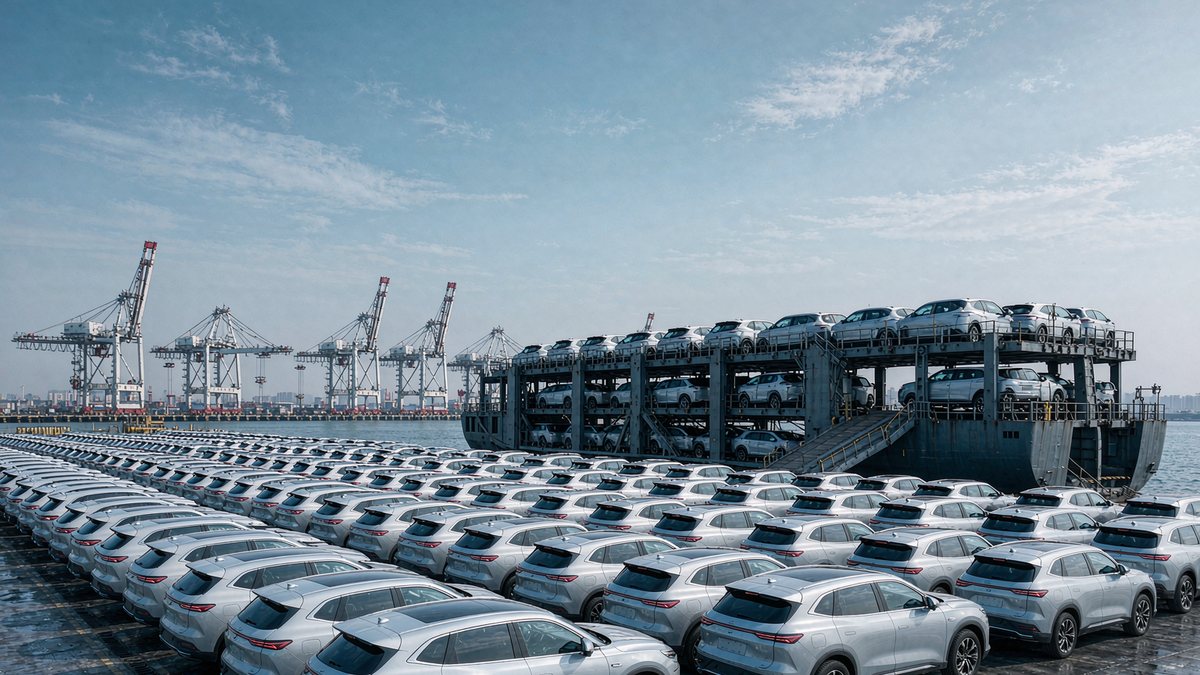
New vehicles waiting at an export dock (AI-generated image).
01 Three numbers, three turning points
First number: 1.010 million units, -3.5% month on month, +65.3% year on year.
CAAM’s 10 September release for August showed vehicle exports of 1.010 million units, up 65.3% year on year and down 3.5% from July. The headline is the third straight month above a million. The year-on-year growth is still high, and the month-on-month dip is better read as high-level consolidation than a reversal. But the pattern has shifted: exports are no longer setting a new record every month; they are holding a million-unit platform.
Second number: NEV 526,000 units, 52.1% share.
August NEV exports were up 134.6% year on year, while conventional-fuel exports rose 34.7%. Together they made the 1.010 million total, and NEVs accounted for 52.1%. Over January-August, NEV exports reached 3.435 million units, up 124.3%, for a 48% share. The August figure was clearly ahead of the cumulative average, meaning almost all the incremental volume was electric.
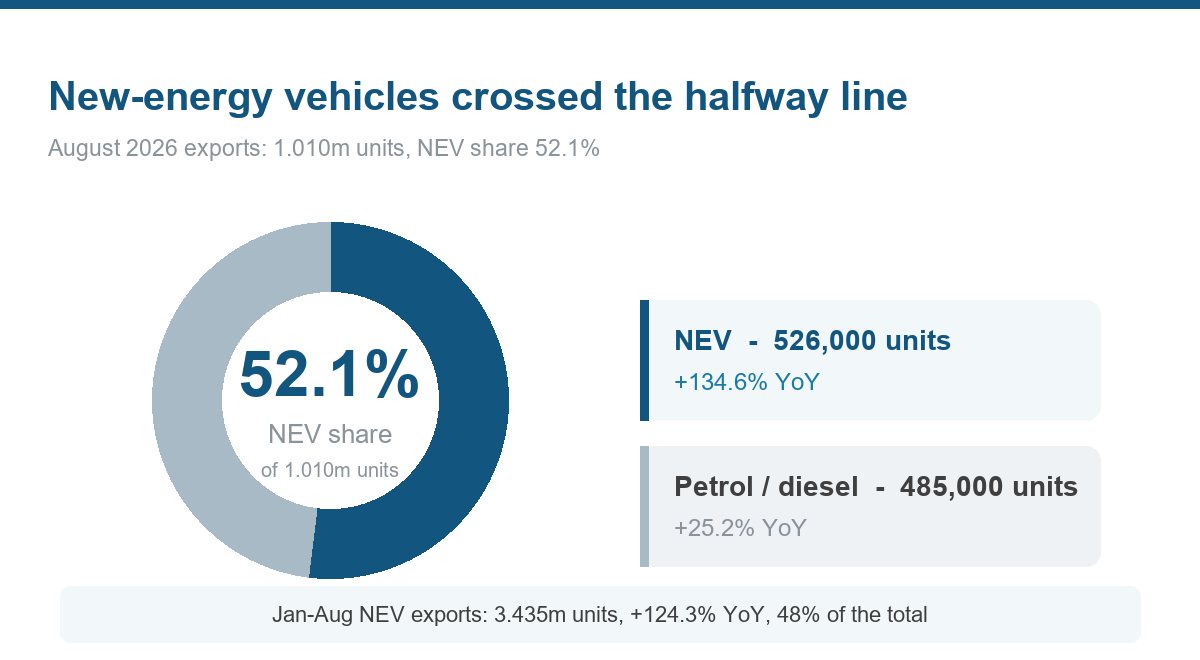
August’s NEV export share crossed the halfway line.
Third number: domestic sales have fallen more than 20% year on year for five straight months.
August domestic sales — total sales of 2.712 million less the 1.010 million exported – came to about 1.702 million units, extending the run of declines seen through the first half, when domestic volumes fell 21.1% year on year. Total sales were up 4.9% on July but still down 5.1% year on year. For OEMs, overseas is not a side market anymore; it is the main one. The same goes for suppliers.
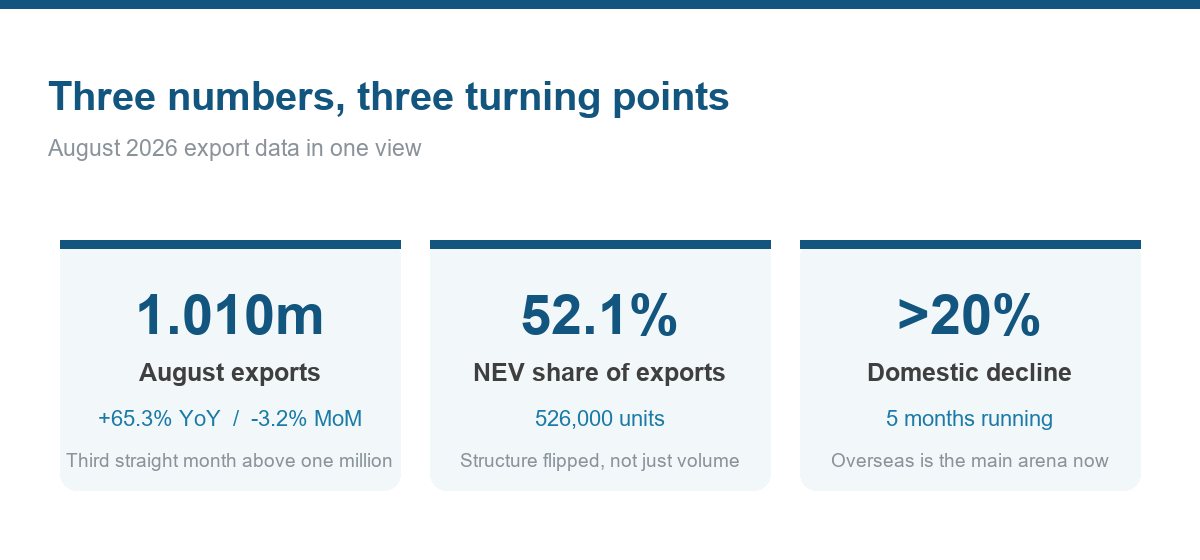
Three numbers: volume holding, structure flipping, home demand soft.
The engine is still running, but the fuel has changed — and so has the track.
02 Carmakers are moving the whole chain abroad
Industry news over the past month points in one direction.
On 14 September, Dongfeng Motor unveiled its “Horizon” overseas plan to 2030: RMB 50 billion committed, more than 50 models, 10 large-scale overseas production bases, 5 overseas R&D centres and 2 overseas finance platforms.
The same day, IAA Transportation opened in Hannover with 1,364 exhibitors, 277 of them from mainland China — roughly one in five. Foton handed over its 13-millionth vehicle on site, delivered an Auman Galaxy 9 to a European customer, and set its Europe target: 50% NEV and 40% international sales by 2030.
In the weeks before:
GAC pushed local production in Egypt in August, introduced three models in Ghana and signed a channel partner in Romania. BYD said it plans to deploy 6,000 fast-charging stations overseas within a year. Chery’s South Africa plant started production in July, retaining 692 existing employees and expecting to support around 3,000 supply-chain jobs; in Spain it revived the Ebro brand with a local partner.
R&D, production, distribution, service and finance — the whole chain is being relocated. Product export is over; system export has just begun.
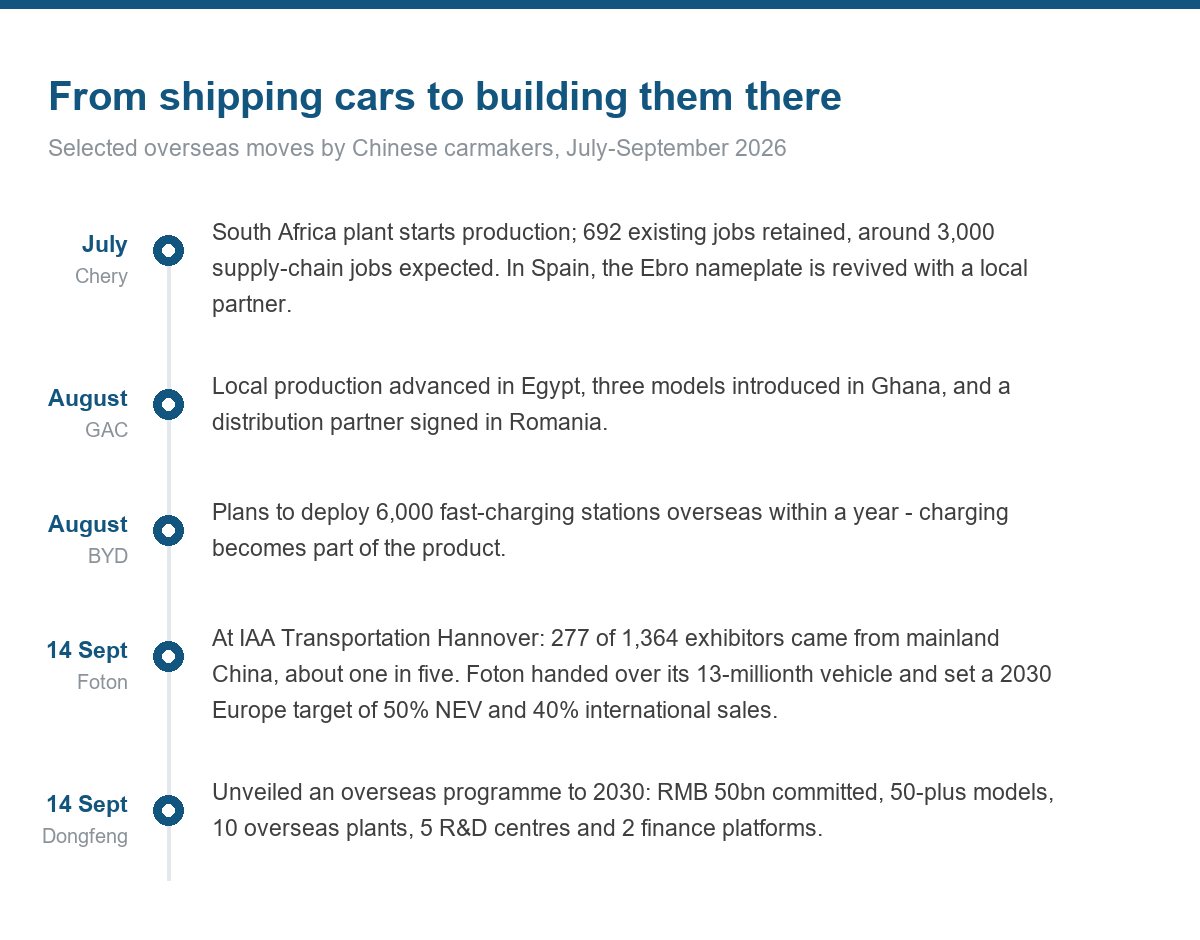
Selected July-September 2026 moves, all pointing to local operations.
03 Supplier work is moving from cross-border to in-market
For suppliers and service providers, the shape of the business is changing.
In the past the job was transport: build in China, ship by ro-ro, hand over at the destination port. Now that OEMs are becoming operators abroad, the job is fulfilment: build the car there, sell it there, keep it running there, and settle payments there.
Four categories of work are getting thicker:
Local warehousing and parts — once overseas plants start, regional parts hubs become non-negotiable.
Homologation and compliance — every market has its own access and type-approval rules; certification and local adaptation are long-term recurring work.
Cross-border finance and settlement — building plants and channels needs capital, which brings treasury and supply-chain finance demand.
Local service networks — authorised repair, technician training and charging-network operations become more valuable the deeper the market gets.
The rule of thumb: following the car is a shipping job; following the plant is a fulfilment job. The latter has higher stickiness and better pricing power.
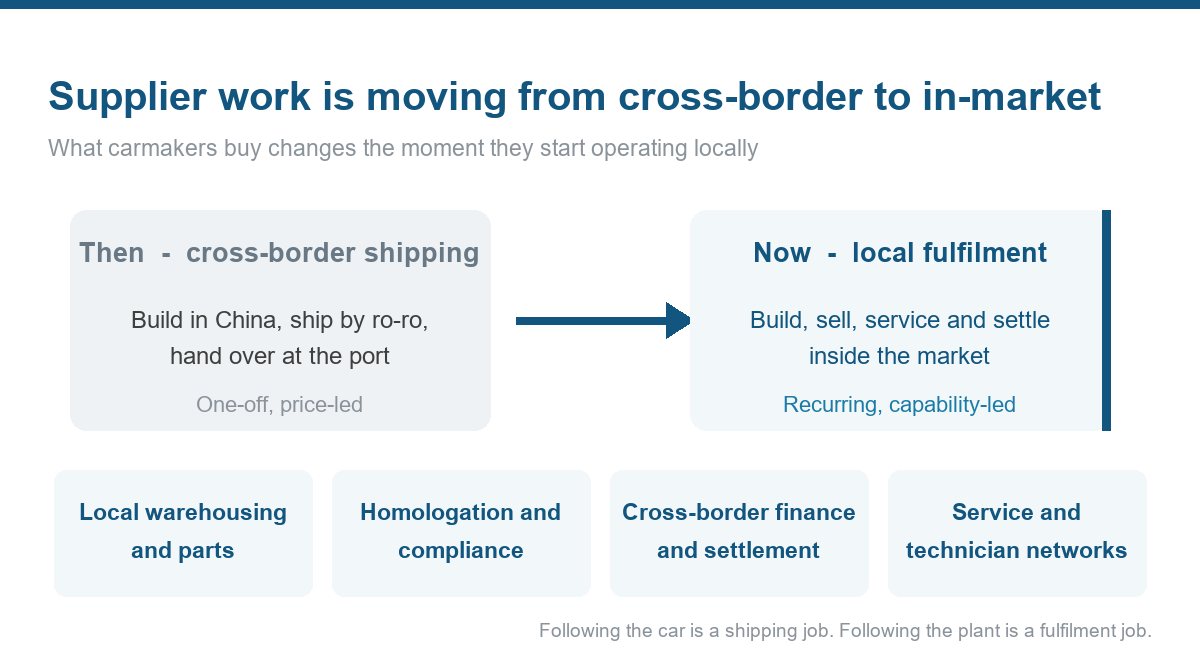
Demand is shifting from “ship the car” to “operate the market”.
04 Three reminders
Watch payment terms. A recent State Council executive meeting targeted overdue payments from large enterprises to smaller suppliers. Suppliers in the chain stand to benefit if enforcement follows.
Do not look only at passenger cars. In H1, commercial-vehicle exports reached 664,000 units, up 32.5% year on year and equal to 28.9% of total commercial-vehicle sales — close to one in three. CV parts and aftersales remain under-served.
Follow the plant, not just the monthly shipment. Judge a market by whether Chinese OEMs are building factories, channels and service networks there. Where there is a plant, there is durable supplier demand.
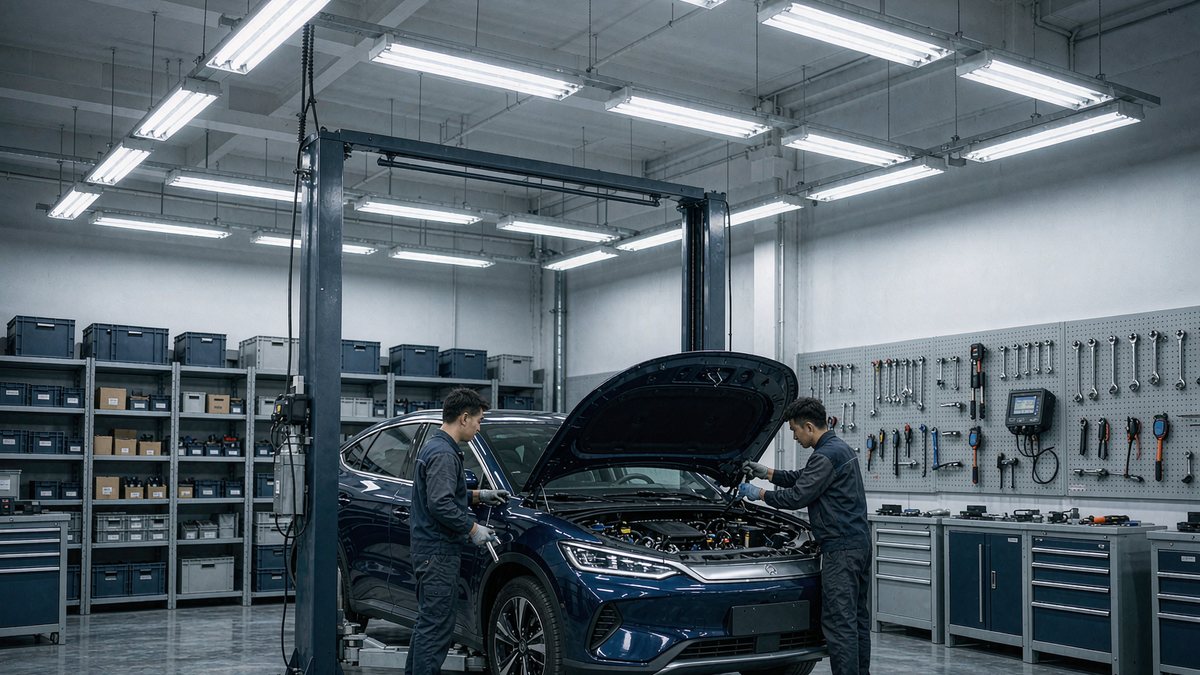
Overseas local service network: plant, parts and technicians (AI-generated image).
Closing
August’s month-on-month dip is not bad news. It is a signal.
The phase of pulling volume through pure vehicle trade is running out of road. What comes next is a contest over how deeply OEMs root themselves abroad — and who can put down service roots alongside them.
The migration from “selling cars” to “making cars there” is just getting started.
About MUYAN
MUYAN tracks China’s automotive go-global industry — exporters, component suppliers, logistics providers and compliance teams — and turns industry data into decisions you can act on.
Data notes: CAAM = China Association of Automobile Manufacturers (complete-vehicle export basis).
Sources: CAAM August 2026 vehicle export data (10 September release); Dongfeng Motor “Horizon” overseas plan; Foton Motor Europe strategy and IAA Hannover 2026 information; GAC Group, BYD and Chery public disclosures dated 12-14 September 2026. All figures are public-domain citations; please verify against official releases before quoting.