

5.096 million vehicles.
That is how many vehicles China exported in the first half of 2026. The year-on-year gain is 65.3%, and the half-year tally crossed the five-million mark for the first time on this basis.
Over the same six months, domestic passenger and commercial vehicle sales totalled 9.921 million units, down 21.1%. One market is under pressure at home, the other is running hard abroad.
For anyone in the auto go-global chain, the message is not simply that exports are strong. It is that overseas sales are no longer the optional channel — they are becoming the channel that decides who survives.
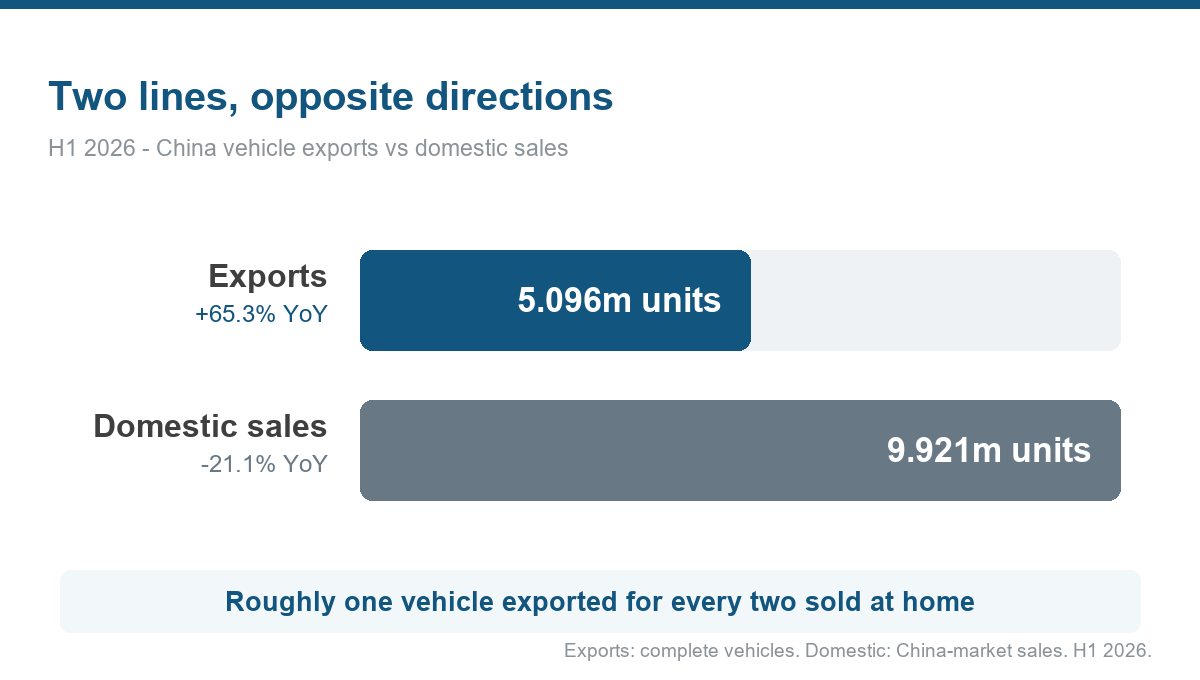
The same half-year, two opposite directions.
01 Scale, structure and run-rate
The first thing to grasp is scale. H1 exports passed 5 million units on a 65.3% gain. June alone shipped 1.037 million units, up 75.1% year on year. The monthly run-rate is now around a million units.
The second thing is structure. New-energy vehicle (NEV) exports reached 2.355 million units, up 120% year on year and accounting for around 46% of total exports. Put differently, roughly one in every two exported vehicles is now electrified.
The third thing is the forward view. CAAM officials have floated a 2026 full-year export forecast above 10 million units. If that happens, it would be a very high annual number for a single-country origin, but it remains a forecast.
Together, the three gauges say the same thing: China’s automotive export push is past the experimental stage.
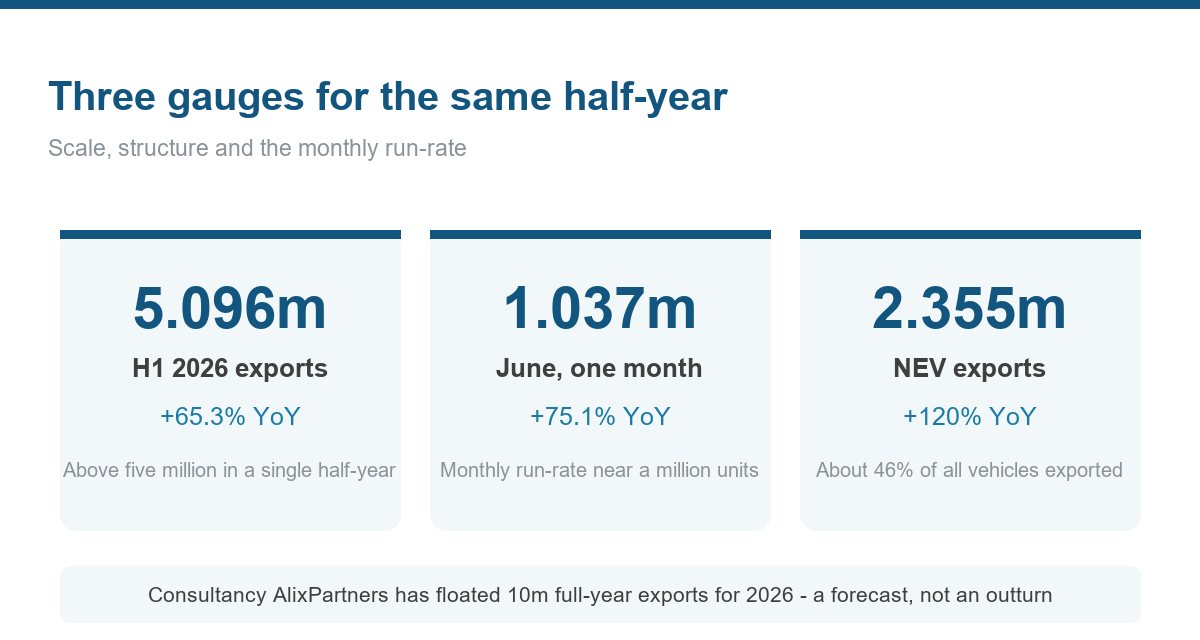
Three gauges: volume, monthly run-rate, and NEV share.
02 The top ten take almost everything
Export growth is not evenly shared.
Chery led H1 with 943,800 exported units, up 71.5% year on year and around 18.5% of total exports. BYD followed with roughly 789,400 units, up close to 70%. The two companies alone accounted for just over 38% of the top-ten total.
The full top ten shipped 4.511 million units, equal to 88.5% of all exports. The remaining carmakers split the other 11.5%.
Head concentration is no longer a forecast; it is the table as it stands. Their strategies differ: Chery has spent years building channels and local operations in Latin America, the Middle East and Southeast Asia; BYD is leading the charge in electrified exports to Europe, South America and Southeast Asia. One is deep, the other is fast. For suppliers, that matters: the capabilities Chery asks for are not the same as the capabilities BYD asks for.
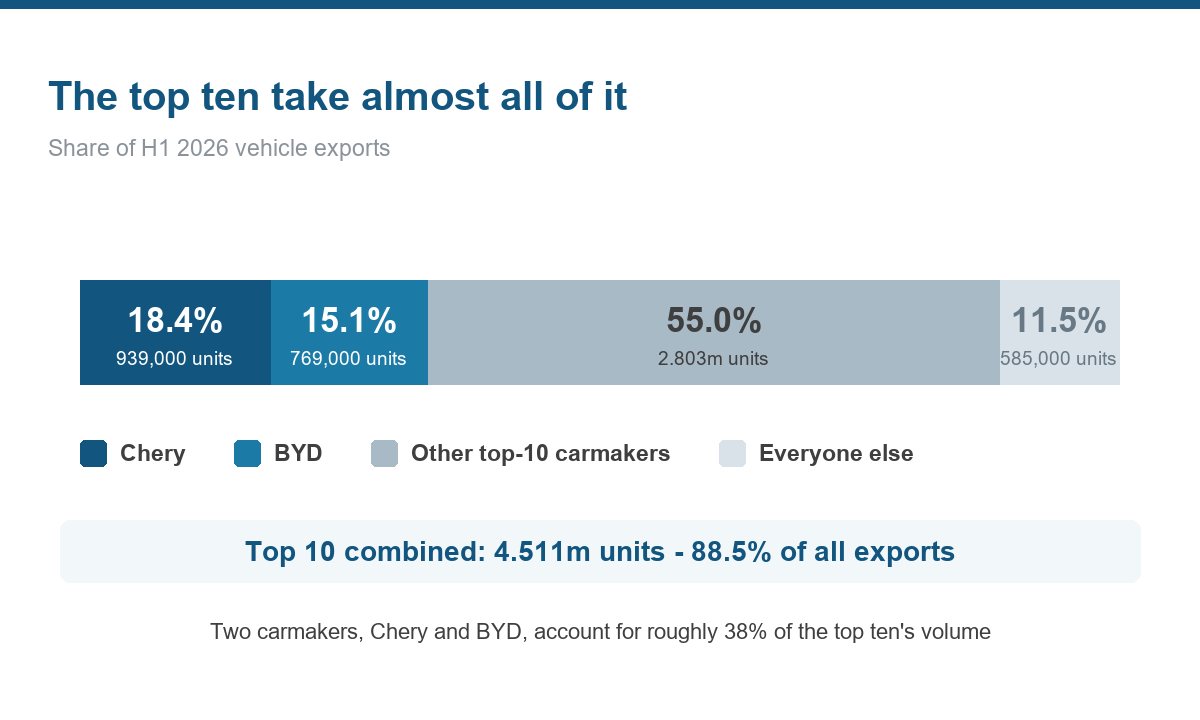
The top ten carmakers took 88.5% of H1 exports.
03 The destination map is being redrawn
The most under-read change in the first half is the reshuffle of destination markets.
Compared with the full-year 2025 ranking, the H1 2026 top-ten export destinations shifted meaningfully: Russia moved back to the top spot; Brazil jumped to second; Italy and Algeria entered the top ten. At the same time, Mexico and the UAE fell sharply, while Saudi Arabia and Kazakhstan dropped out of the top ten.
Regional diversification is also advancing. Latin America and the Caribbean is now the largest export region, accounting for more than 20% of the total. Europe is where the reshuffle is fastest: the United Kingdom, Belgium, Italy and Spain all sit in the top ten. Russia, Southeast Asia and the Middle East each account for close to a tenth.
What this means: China’s auto exports are moving from concentration in a few markets to a wider spread, reducing dependence on any single country.
The practical warning is that markets that fall down the ranking usually do so for a reason — tariffs, local-content rules, currency pressure or consumer-credit tightening. The gold market of last year can become the re-calculation of this year. Building flexibility into regional planning matters more than getting one market right.
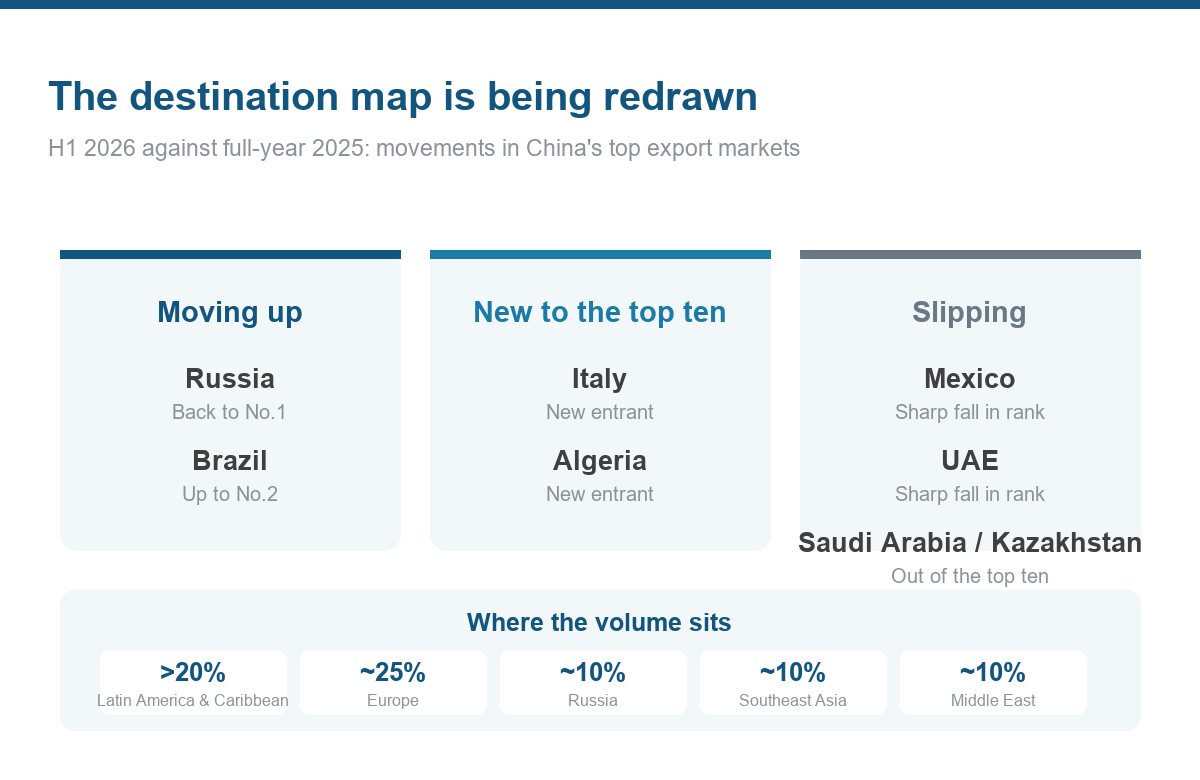
The destination ranking changed: Russia and Brazil moved up; Mexico and the UAE slipped.
04 From price to system: where the new work is
Volume gets the headlines, but the quality of the export business is what decides who wins.
Industry estimates put Chinese-brand NEVs at about 24% of overseas passenger-vehicle markets, up nine percentage points from a year earlier. Leading carmakers are no longer just shipping finished vehicles: Chery alone has eight major overseas vehicle plants, and more Chinese OEMs are building factories, channels and aftersales networks abroad.
The competition is shifting from price to system — distribution, compliance, aftersales and local operations are becoming the decisive factors.
That creates new work for the supply chain. Around exports, five service lines are thickening: logistics, warehousing, finance, aftersales, and used-car export. The simple test is this: when a carmaker’s role abroad changes from seller to operator, the outsourced services it needs only grow.
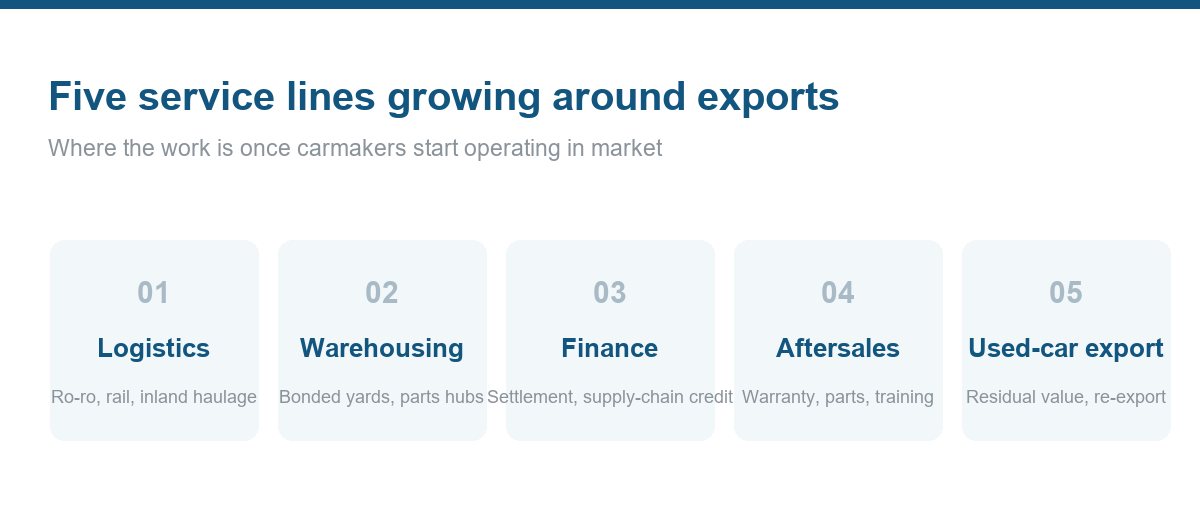
Five service lines worth rebuilding around the export business.
Closing
5.096 million units is a milestone, not a finish line.
The first-half scorecard shows three changes at once: volume is reaching new highs, the top is concentrating, and the map is reshuffling. Exporting is moving from a volume rally to a quality upgrade.
What will determine how far Chinese cars travel is not the annual export count; it is how deep the roots go in each market.
That race is still in its early laps.
About MUYAN
MUYAN tracks China’s automotive go-global industry — exporters, component suppliers, logistics providers and compliance teams — and turns industry data into decisions you can act on.
Data notes: export figures are reported on a complete-vehicle basis. Year-on-year comparisons and top-ten rankings use publicly disclosed industry data; full-year forecasts are attributed to CAAM officials.
Sources: China Association of Automobile Manufacturers (CAAM) and industry data providers, H1 2026 vehicle export statistics; CAAM 2026 full-year export outlook. All figures are public-domain citations; please verify against the latest official release before quoting.