

Last verified: 21 September 2026. Confirm current GSA and Ghana Revenue Authority requirements with licensed clearance agents before shipment.
The Ghana Standards Authority (GSA) has confirmed that from 1 October 2026 it will enforce GS 4510:2022, the standard governing imported used vehicles, and will apply full Pre-export Verification of Conformity (PVoC) to every shipment. The operating rule is four words: no Certificate of Conformity (CoC), no entry. As this issue goes out, ten days remain.
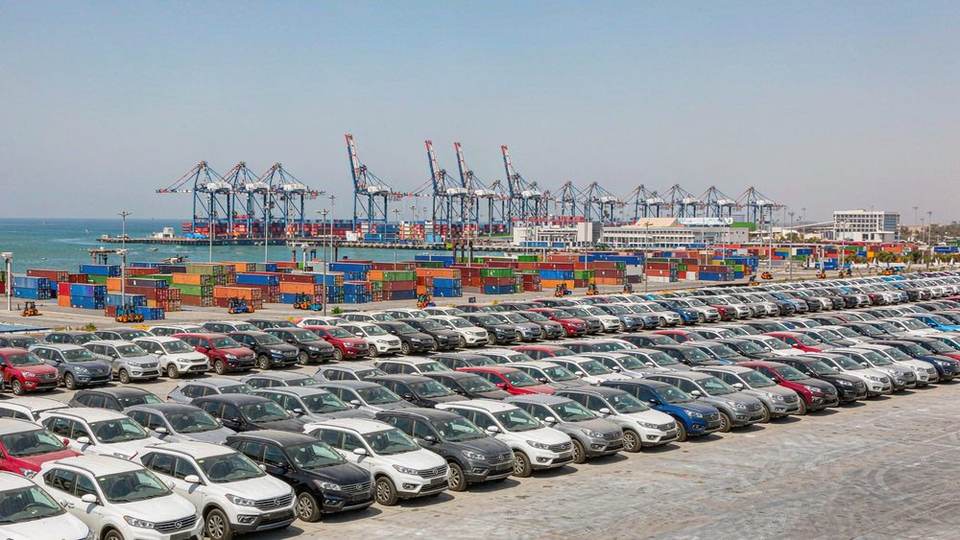
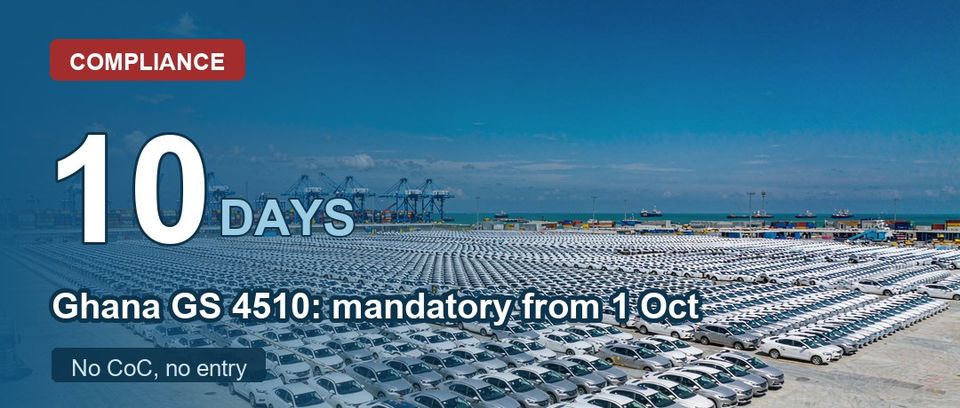
One correction before the detail. Much of the coverage circulating on this describes a Ghanaian ban on used-vehicle imports and a shake-out across West Africa. That reading is wrong, and it is the kind of wrong that makes operators walk away from a market they should be preparing for.
1. What this actually is: not a ban, but harder to route around
GSA’s own notice is clear on the point. This is not a prohibition on importing used vehicles. It is a requirement that imported vehicles meet defined safety, quality and environmental standards.
Ghana’s National Vehicle Type Approval and Conformity Assessment Programme has in fact existed since 2020. For six years it sat largely on paper — an over-age vehicle paid a fine and was waved through.
So the real change is narrower and more specific than the headlines suggest:
- Used vehicles remain admissible, and the market stays open to Chinese supply.
- What has closed is the tolerance route. Over-age vehicles no longer pay to pass — they are refused entry.
The practical difference is large. The first reading says keep trading. The second says your sourcing standard and your documentation process both have to change.
A second correction is also needed. Several accounts describe a zero-tolerance position on condition, with any accident history an automatic rejection. The standard does leave room: minor cosmetic scratches and repairable non-structural defects do not block verification, provided the vehicle is otherwise roadworthy. What is barred is structural damage — cracking, twisting or deformation of the chassis or safety cage — together with flood and fire damage. Resprayed panels are not the issue; a distorted chassis is.
Watch for movement on timing. Ghanaian trade bodies including the Chamber of Autodata Ghana and the Vehicle Asset Dealers Union of Ghana have asked GSA to defer implementation, citing clearance disruption and higher transport costs. Plan against 1 October, and keep one eye on the outcome.
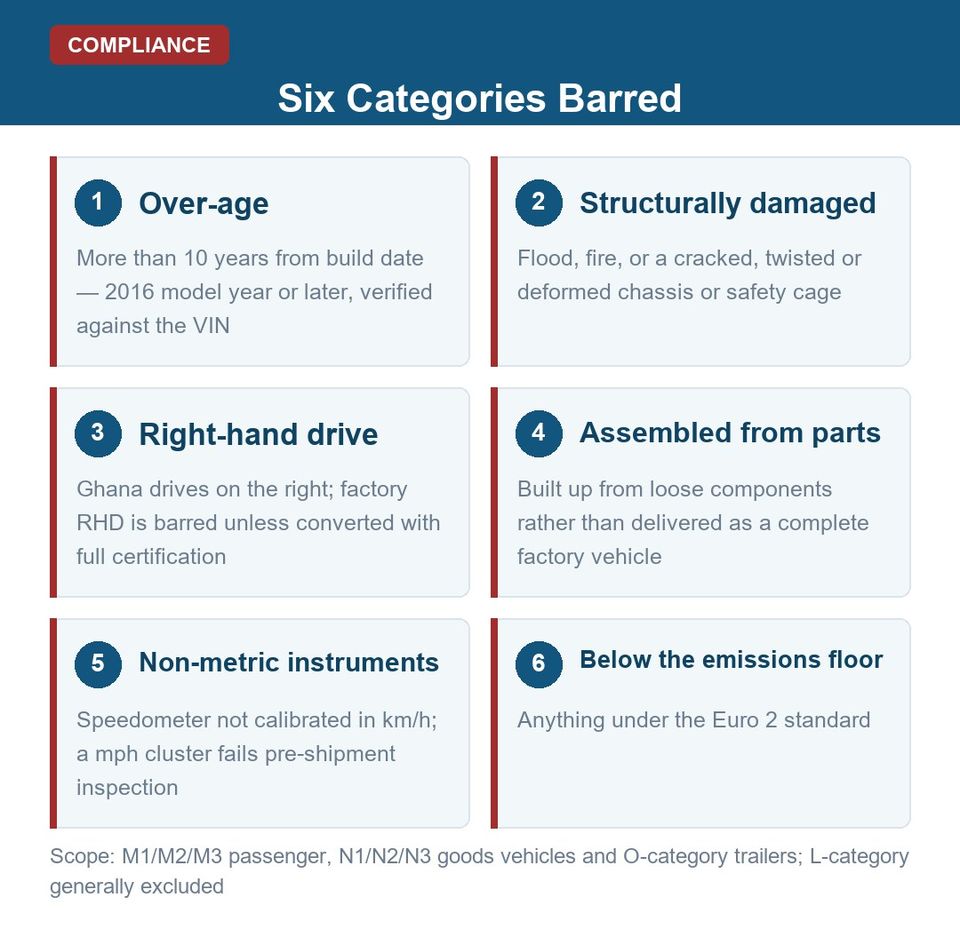
2. Six categories are barred outright
This is the table to run your existing stock against today.
| Category | Test applied |
|---|---|
| Over-age | More than 10 years from date of manufacture. Against a 2026 enforcement date this means 2016 model year or later. Build date and model year are not always the same — verify against the VIN. |
| Structurally damaged | Flood or water immersion, fire, or cracking, twisting or deformation of the chassis or safety cage. Minor repairable non-structural defects are excluded. |
| Right-hand drive | Ghana drives on the right. Factory right-hand-drive vehicles are barred. Vehicles converted to left-hand drive under an approved programme and carrying full certification may qualify; ordinary RHD stock does not. |
| Assembled from parts | Vehicles built up from loose components rather than supplied as a complete factory vehicle. |
| Non-metric instrumentation | Speedometers not calibrated in km/h. A mile-per-hour cluster fails pre-shipment inspection: no certificate, no clearance. |
| Below the emissions floor | Anything under the Euro 2 standard. |
Scope: M1/M2/M3 passenger vehicles, N1/N2/N3 goods vehicles and O-category trailers. L-category vehicles — motorcycles among them — are generally excluded. New vehicles run through a separate GSA type-approval channel and are not subject to the ten-year age rule.
3. Four stages, and the CoC is the only document that counts
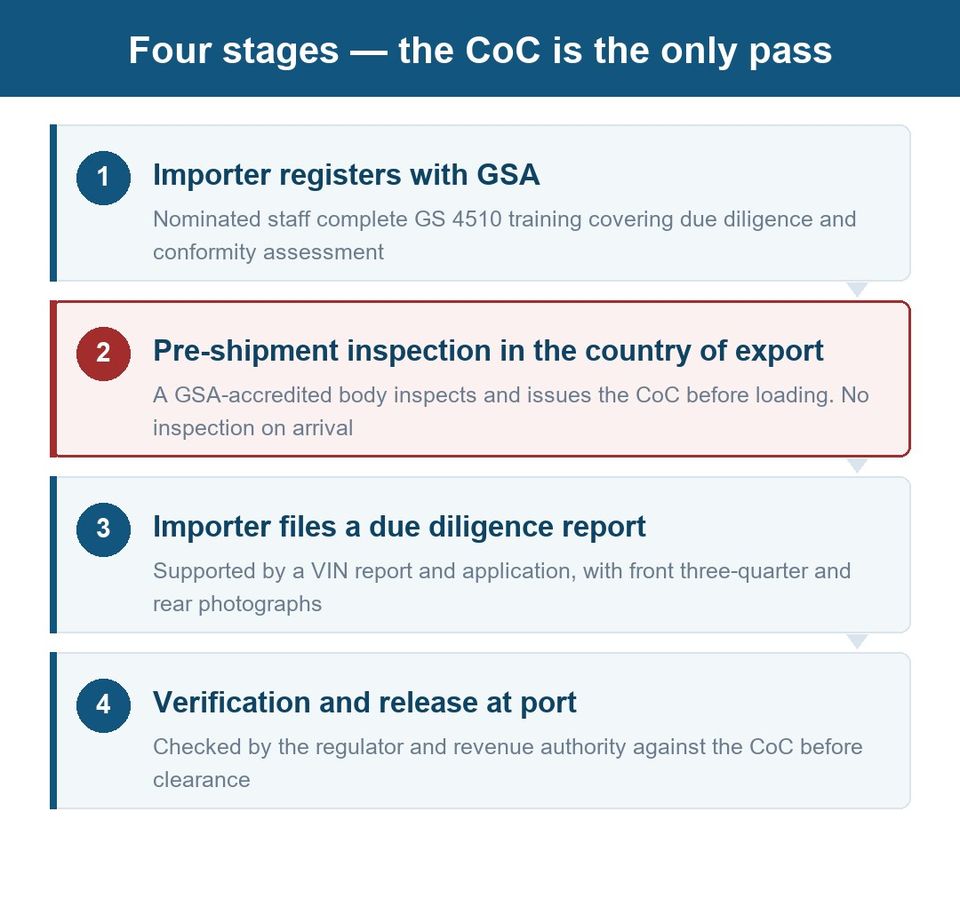
Most summaries describe two steps: do PVoC, get a CoC. The full sequence is four, and all four are required.
Stage one — the importer registers with GSA
Importers, distributors and dealers bringing in used vehicles must register with GSA. Nominated staff are generally required to complete training on GS 4510 covering due diligence, conformity assessment, reporting and procedure. Private imports of personally owned vehicles may be restricted or require specific permission.
Stage two — pre-shipment inspection, completed in the country of export
A GSA-accredited third-party inspector inspects the vehicle before it is loaded for export and issues the CoC. The inspection covers:
- VIN verification and document validity;
- safety condition — steering, brakes, seatbelts, lighting and retro-reflective devices, and airbag function;
- emissions at or above Euro 2;
- no major accident or flood history, and structural integrity intact.
This is the stage the whole process turns on. It must be completed before loading. Ghana does not offer inspection on arrival and does not make special-clearance exceptions. Uncertificated cargo is held at port, and demurrage and re-shipping costs follow.
Stage three — the importer files a due diligence report
Before import, the importer submits a due diligence report confirming conformity, supported by a VIN report and a conformity assessment application that includes vehicle photographs — at minimum a front three-quarter view and the corresponding rear view.
Stage four — verification and release at port
On arrival, the vehicle is checked by the regulator and the revenue authority against its CoC and supporting documents before it can clear. The usual set is the vehicle import application or importer due diligence report, the VIN report, the vehicle inspection report, and the vehicle clearance certificate.
Ghana has also brought VEDIS, the Vehicle Dealer Information System, into service. It consolidates data from the Driver and Vehicle Licensing Authority (DVLA), insurers and Interpol, and checks vehicle records in real time. The room for forged documents, recycled certificates and wound-back odometers is close to gone.
4. The trap almost everyone misses: 35–45 days at sea
This one earns its own section, because it is where real losses will come from and it is the least reported part of the change.
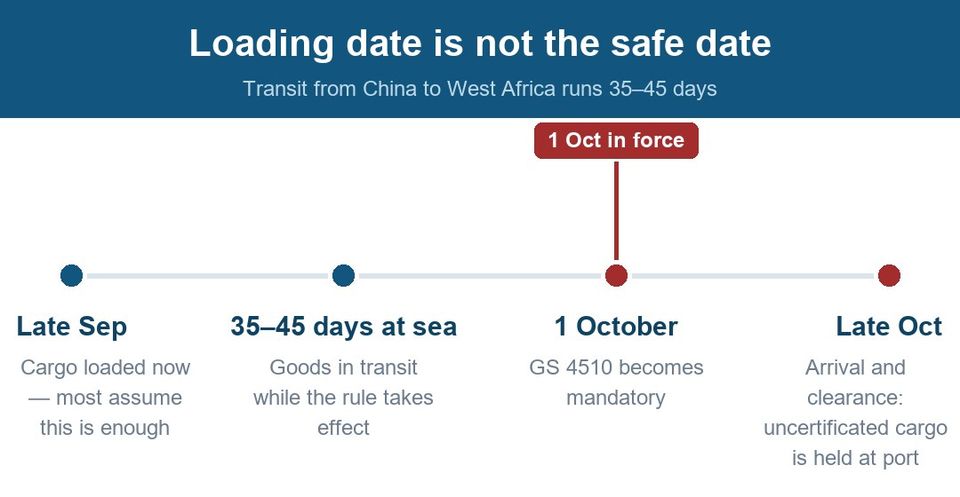
The common assumption is that loading before 1 October solves the problem. It does not.
Enforcement is assessed at arrival and clearance, not at loading and departure. Transit from China to West Africa runs 35 to 45 days. Cargo loaded now, in late September, lands after 1 October and falls squarely inside the new regime.
So ten days is not a preparation window — it is already a tight one. If you have August or September shipments on the water whose age or instrumentation sits on the wrong side of the line, reassess them now rather than waiting to be stopped at the port.
5. Duty load, and two exemptions
From published industry sources, the aggregate tax burden on vehicle imports into Ghana is roughly:
- base import duty of 5%–20%, graded by engine displacement;
- plus ECOWAS levy, education fund levy, health insurance levy and 15% VAT;
- an effective total in the region of 35%–45% of CIF value.
These are compiled from public industry sources. Confirm the specific headings and rates against the current Ghana Revenue Authority (GRA) tariff.
Two exemptions are worth holding on to:
- New vehicles — not subject to the ten-year age rule, but still fully subject to PVoC and emissions requirements, through the GSA type-approval channel.
- Local CKD assembly — assembly operations inside Ghana qualify for duty relief. Relevant for brands planning a long-term position.
6. What to do now
- Re-screen every unit you hold. Filter on five fields: build year, left- or right-hand drive, instrument calibration, emissions level, structural damage history. Pull the borderline units out and deal with them separately — do not ship them mixed with compliant stock.
- Confirm your CoC route. Engage a GSA-accredited inspection body now and establish the booking lead time and certificate turnaround. This is the single step that decides whether you can ship at all, and it sits at the top of the list.
- Check your importer’s GSA registration. If your counterparty is not registered, or their nominated staff have not completed GS 4510 training, your cargo will not clear on arrival regardless of its condition.
- Recalculate on arrival date, not loading date. Add the 35–45 day transit to every shipment and work out where each one lands relative to 1 October.
- Track the deferral request. Local trade bodies have asked for a delay. If GSA softens, shipping rhythm can be adjusted — but until an official change is published, prepare against 1 October.
If you are buying from China
For overseas dealers and fleet buyers, this reduces to a short list of things to require from your supplier before you release payment:
- a VIN report and confirmed build date, so the ten-year test is settled before loading;
- confirmation the vehicle is left-hand drive with km/h instrumentation;
- an independent third-party inspection report covering condition and structural integrity — not photographs alone;
- written confirmation that pre-shipment inspection has been booked and the CoC will be issued before loading, not “arranged on arrival”;
- a realistic arrival date, calculated with transit time included.
A supplier who cannot produce these five is not a supplier for this market after 1 October.
Wider context
Ghana follows Nigeria’s tightening of age and emissions rules. West Africa’s used-vehicle market is moving as a bloc towards compliance, better-condition stock and younger fleets.
For Chinese suppliers this is not simply bad news. What the new standard removes is cheap old stock and right-hand-drive channels. What it rewards is newer, left-hand-drive, fully documented vehicles — which is what the current Chinese supply base is built around. The near term is higher cost and disruption. The medium term is a cleaner competitive field, where the contest is not on price alone but on documentation, condition and supply-chain reliability.
Sourcing through MUYAN AUTO
MUYAN AUTO supplies inspected used and new vehicles from China to overseas dealers and fleet buyers. Every unit we ship carries an independent third-party inspection report, and we coordinate pre-shipment inspection and CoC issuance with GSA-accredited bodies before loading. If you need stock that clears Ghana under GS 4510, or you want the one-page shipment self-check list for this standard, reach us through muyanauto.com.
Source: Ghana Standards Authority notice of 5 August 2026; GS 4510:2022, road vehicles — technical requirements for imported used motor vehicles; Ghanaian media reporting including Graphic and Citinewsroom. Official enquiries: GSA Vehicle Certification Unit, auto@gsa.gov.gh, +233 30 398 0177, gsa.gov.gh. Compiled from public information for industry reference; the applicable text is the GSA official release together with current Ghana Revenue Authority regulations. Duty ranges and transit times quoted here are industry estimates and not official commitments.
About MUYAN AUTO
MUYAN AUTO is a China-based sourcing and compliance partner for overseas dealers, distributors and fleet buyers across the automotive and agricultural-machinery supply chain. We publish market data, homologation timelines and cost breakdowns for buyers importing from China, and we coordinate third-party inspection, pre-shipment verification and shipping documentation on the ground. Full briefings, checklists and current stock are published at muyanauto.com.