
Buyer brief
Before requesting a quote
- Identify a local repair provider and parts supplier before choosing equipment; ask for lead times and a written service scope.
- Compare suitability for local working conditions and ongoing maintenance, not horsepower or purchase price alone.
- This is a farm-machinery industry note. Its statistics do not establish the performance, availability or price of any vehicle on this website.
Review scope and unresolved items
The China Industry News interview, reproduced by Sina, reports the headline tractor-export figures and discusses reliability. CCCME provides separate export and service-network context. These are not vehicle inspection records; the quoted Customs figures have not been checked against the original Customs table in this review.
RMB 5.38 billion. Up 23.6%.
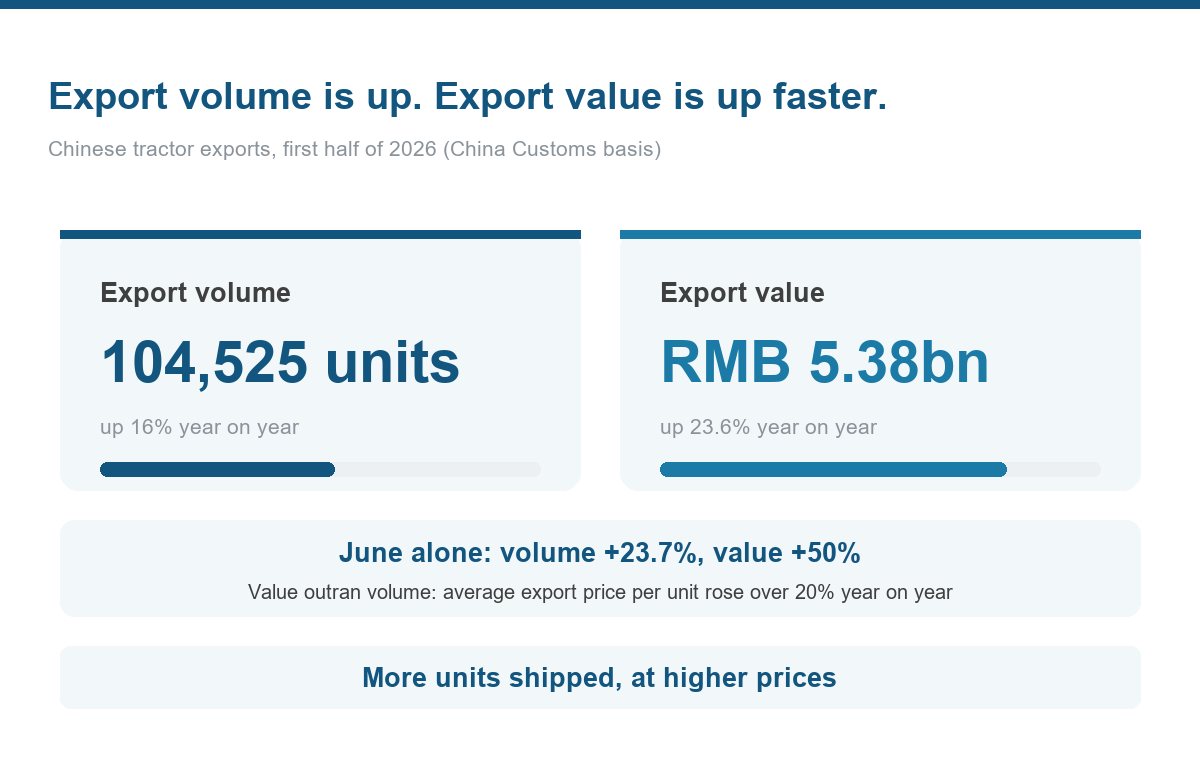
That is China's tractor export report for the first half of 2026: 104,525 units shipped, up 16% year on year, and RMB 5.38 billion in value, up 23.6%.
The headline numbers look good. The more interesting comparison is the average price. Exported tractors averaged about RMB 51,500 per unit in the first half of 2026. Imported tractors averaged about RMB 976,000 per unit — roughly nineteen times as much.
What does that mean? It means Chinese tractors are no longer just a low-price volume play; they are starting to sell at higher prices. It also means the premium segment is still a long way from being cracked.
If you have been following China's vehicle exports, this will feel familiar. The path farm machinery is taking now looks a lot like the path cars took a few years ago.
01 More units, and higher prices
A few concrete moves show where the trend is coming from.
YTO Group exported 8,006 tractors in the first half of 2026, up 47% year on year. Weichai Lovol launched its E4104-8H hybrid tractor in May: 410 horsepower, an in-house ECVT electronic continuously variable transmission, transmission efficiency up more than 10% and fuel consumption down about 20%. Zoomlion unveiled its DV3504 hybrid tractor at the Mozambique agricultural show, aimed at smallholders and cooperatives. YTO also shipped 40 customised high-horsepower tractors to Kazakhstan.
The leading players are pushing towards larger horsepower, intelligence and hybrid power. That has lifted the average export price of tractors by more than 20% year on year. A few years ago Chinese tractors were seen as cheap, rugged and small. That label is now being rewritten.
But hold the applause for a moment.
02 Exports sell on scale, imports sell on technology
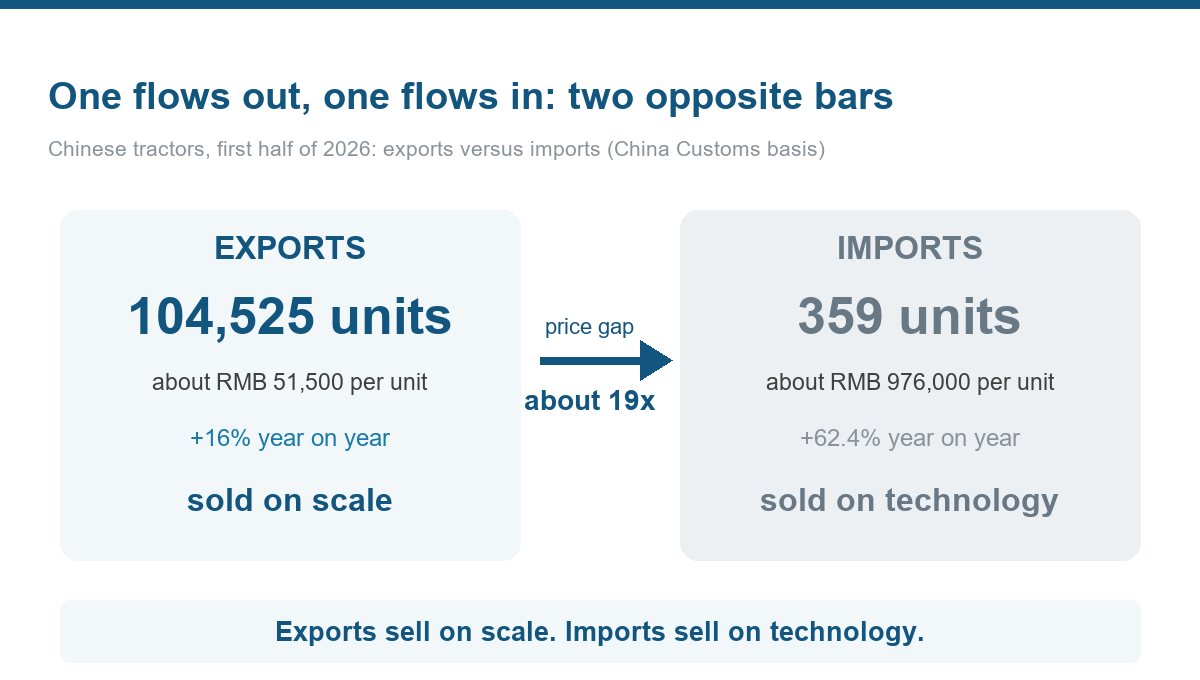
In the first half of 2026 exported tractors averaged about RMB 51,500 per unit. That sounds healthy — until you look at the import side. Imported tractors averaged about RMB 976,000 per unit.
In other words, one imported tractor costs about the same as nineteen exported tractors. Export volume was 104,525 units; import volume was 359 units. The quantity gap is almost 300 to one, but the price gap is about 19 to one.
Farmers Daily summed it up in eight characters: exports sell on scale, imports sell on technology. Uncomfortable, but accurate.
The high-horsepower segment above 300 hp and large combine harvesters are still dominated by John Deere, CNH and other Western brands. Chinese makers already rank among the largest by unit volume, but on reliability, durability and mean time between failures they still lag imported machines by a wide margin.
That is not pessimism. It is room to grow. Prices have moved up; brand trust and technical reputation will take a few more years to earn.
03 Two different markets: Africa wants repair, Latin America wants local build
Farm machinery exports share another feature with vehicle exports: different markets read from completely different playbooks.
Africa needs compact, simple tractors that are easy to fix. Smallholders dominate, terrain is mixed, and parts availability matters more than anything else. One model for every market does not work. Zhejiang Sifang's approach is a good example: wider tracks for soft Indonesian soil, upgraded water-cooling systems for Suriname's heavy duty cycles, and crawler rotary tillers for Vietnam's heat.
Latin America runs on a different logic. Brazil and Argentina have large, contiguous farms and strong demand for tractors above 200 hp and no-till seeding equipment. But Brazilian tariffs are high, so complete vehicle imports are expensive. Many companies are now exploring CKD assembly.
So Africa asks, "Can you fix it?" Latin America asks, "Can you build it here?" Both answers point to the same thing: you cannot just sell the machine; you have to put down roots.
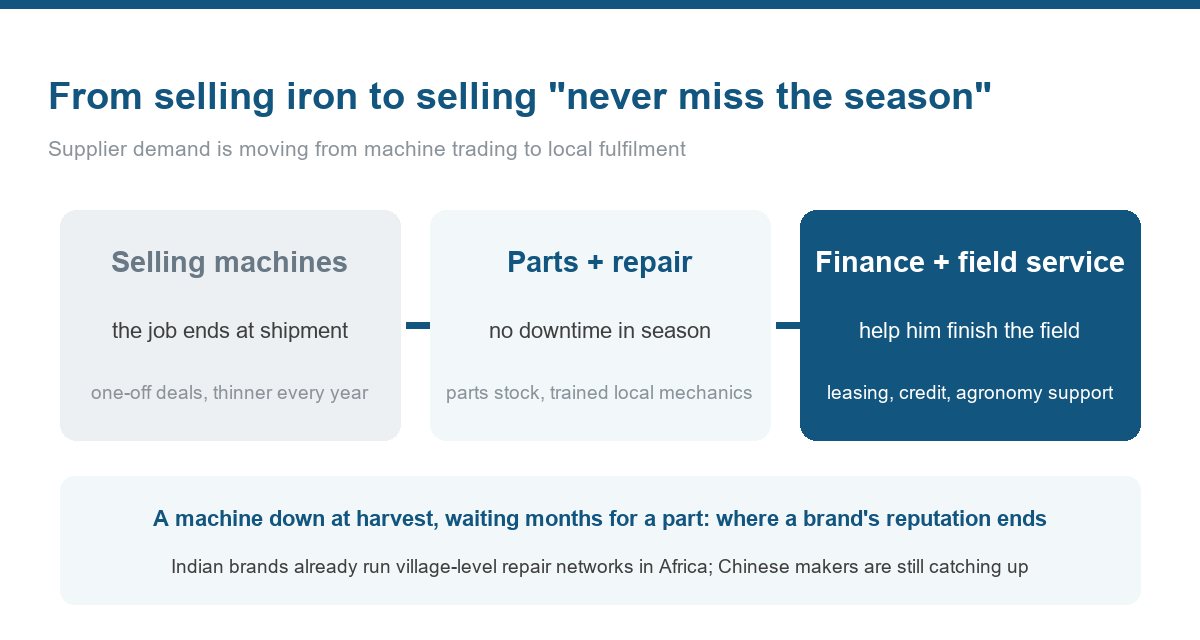
04 From selling iron to selling "never miss the season"
Vehicle exports today are about local fulfilment. Farm machinery should have been about local fulfilment from the start, because a tractor cannot wait three months for a spare part.
If a machine breaks during harvest and the part has to come by sea for several months, the farmer will not blame the weather. He will blame you. Mahindra has spent years building village-level repair networks in Africa. Chinese makers are still catching up.
Four kinds of supplier opportunity are getting thicker around farm machinery exports:
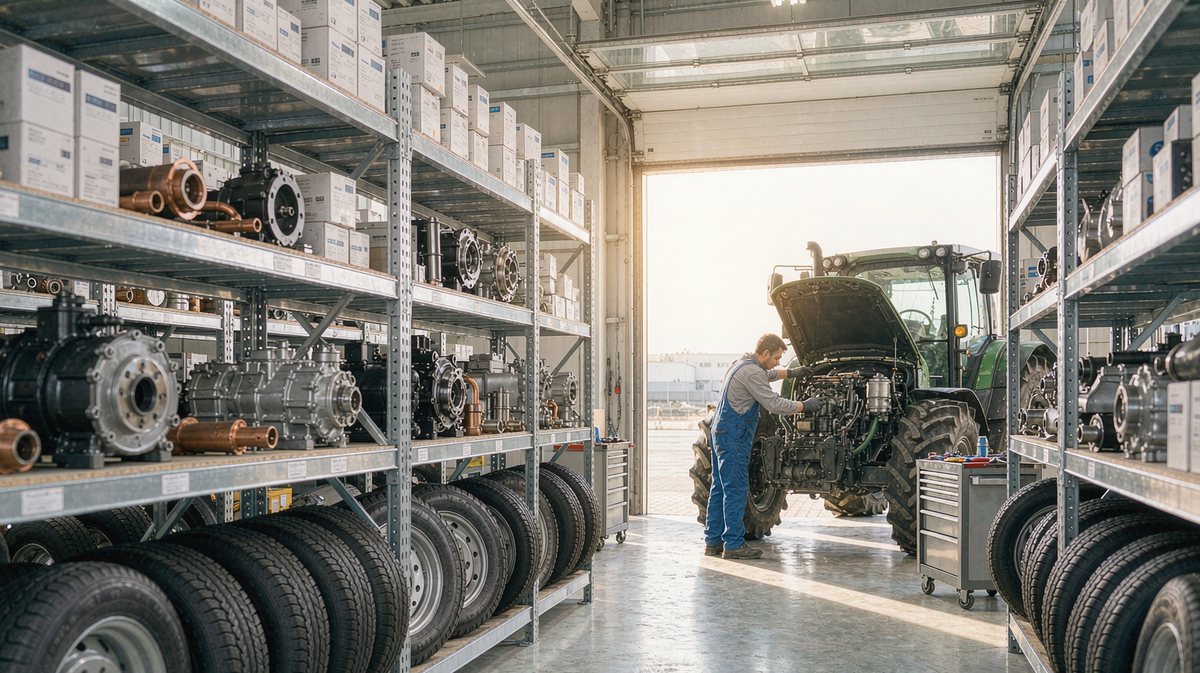
Local parts stock and repair networks – Keeping machines running during harvest is non-negotiable. Regional parts hubs, local mechanics and training are the basics.
Local adaptation and certification – Heat, humidity, dust and salt all matter. Cooling, sealing and anti-corrosion need local tuning. NAFDAC in Nigeria, SABS in South Africa and Brazilian registration are the entry tickets.
Farm machinery finance and leasing – Smallholders struggle to pay upfront for high-horsepower equipment. Instalments, leasing and contract-farming service teams lower the barrier.
Agronomy and field service – Selling the machine is a one-time transaction; helping the farmer finish the season is a long-term business.
One line: selling the machine is dating; keeping it running is marriage. Whoever does the second part well will win the long-term orders.
05 Three reminders
Check foreign exchange before you chase the order. Many African countries face dollar shortages and foreign-exchange controls, so payment cycles are long. Latin American currencies are volatile. Use export credit insurance on large orders; do not stare only at the contract value.
Certification comes first. Do not ship a domestic model straight out. Nigeria, South Africa, Brazil and Kazakhstan each have their own certification and market-access rules. Build the compliance cost into the quote.
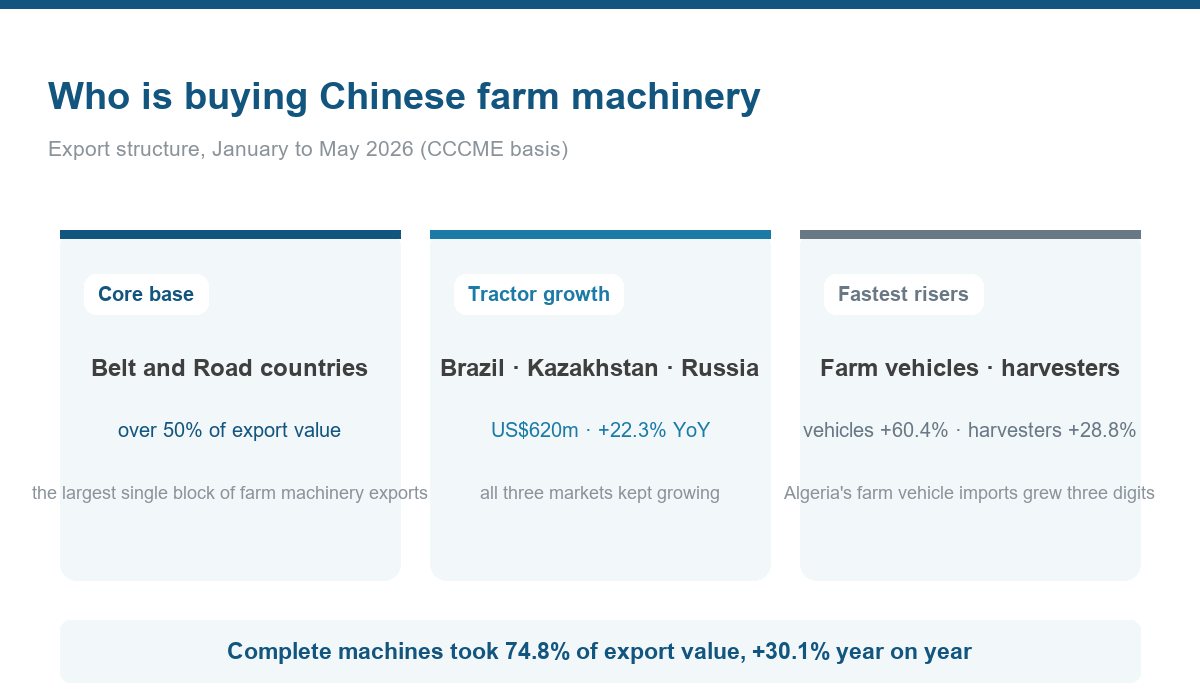
Do not fixate on high horsepower alone. High-horsepower machines are the prestige segment, but compact and mid-size tractors are where the volume is. Belt and Road countries account for more than 50% of farm machinery export value, and the mainstream demand there is still for cost-competitive, mid-range equipment.
Final thoughts
The tractor export figures are encouraging, but what decides whether Chinese makers stay in a market is not the export volume. It is whether an overseas user can find someone, find the part and get the machine fixed quickly when it breaks.
That is the lesson vehicle exports took years to learn, and farm machinery has to face it from day one. The good news is that the potholes have already been mapped by the vehicle-export wave. Following that map will save a lot of tuition fees.
Which parts of the vehicle-export playbook do you think transfer most directly to farm machinery?
About MUYAN
MUYAN Going Global (沐岩出海) is a China-based industry publication covering the automotive and farm machinery export supply chain. We turn monthly export data, overseas moves and market-access rules into decisions that OEMs, component suppliers, logistics providers and compliance teams can act on. Chinese editions are published on WeChat; English editions are published on muyanauto.com.
Reply with the word machinery if you would like the next edition to include a working list of farm machinery certification, finance and after-sales options by market.
Sources: General Administration of Customs of China (GACC), first half of 2026 farm machinery import and export data. China Chamber of Commerce for Import and Export of Machinery and Electronic Products (CCCME), January to May 2026 agricultural machinery and parts export statistics. Farmers Daily, China Daily and China Industry News coverage of China's farm machinery exports. Please check official statistics before publication.
Sources and review notes
MUYAN AUTO · Buyer Resources · Sources checked:
- China Industry News: high-end farm machinery and reliability (Sina reproduction) ↗
Interview and reported H1 2026 tractor exports; secondary publication of the original newspaper report.
- CCCME: China agricultural machinery exports in 2025 ↗
2025 product structure and market limitations, not the 2026 headline statistics.
- CCCME / International Business Daily: technology and local service in farm-machinery exports ↗
Local adaptation, service networks and batch delivery; published 20 May 2026.